American First Class Travel Destinations USA: Premium Route Architecture
Domestic premium aviation within the United States operates under strict yield management and network scheduling rules. American Airlines distributes its front-cabin seats across a diverse fleet, ranging from regional jets to widebody long-haul flagships. Evaluating this network requires understanding how the carrier allocates hardware, grounds infrastructure, and assigns fare basis codes across key domestic destinations.
Airlines allocate premium seats strategically based on market competition and corporate demand profiles. Highly competitive coast-to-coast corridors receive specialized sub-fleets equipped with fully flat beds, direct aisle access, and multi-course dining. Secondary domestic routes rely on standard narrowbody recliners designed primarily to maximize passenger density.
A comprehensive review of domestic premium travel must analyze both inflight hardware and ground facility integration. Exclusive check-in lobbies, expedited security lanes, and dedicated lounge networks significantly enhance overall travel value. Understanding how carriers distribute these premium assets helps travelers select itineraries that deliver genuine operational comfort.
Understanding “american first class travel destinations usa”
Evaluating american first class travel destinations usa requires analyzing aircraft deployment patterns and route schedules rather than relying on general carrier marketing. Domestic front-cabin products vary dramatically depending on assigned tail numbers, flight duration, and competitive pressures. Consequently, a premier transcontinental service on a coast-to-coast route bears little resemblance to a standard domestic first class recliner operating on a two-hour regional leg.
Network-Level Product Discrepancies
Financial managers analyze domestic front cabins through productivity metrics and scheduling integrity. Core travel requirements are satisfied by standard economy seats, so additional expenditures must yield measurable advantages in sleep quality, working environment efficiency, or time savings.
Carrier network planners evaluate premium seat allocation using route-level revenue performance. Densely populated corporate corridors justify capital-intensive widebody aircraft and customized narrowbody suites. Secondary regional destinations rely on standard narrowbody recliners that balance basic passenger comfort with seating capacity.
Structural Realities and Oversimplification Risks
Travelers frequently assume that purchasing a first class ticket guarantees lie-flat seating and complimentary airport lounge access. American Airlines systematically restricts Flagship Lounge entry and lie-flat seat deployments to designated long-haul transcontinental and Hawaii routes.
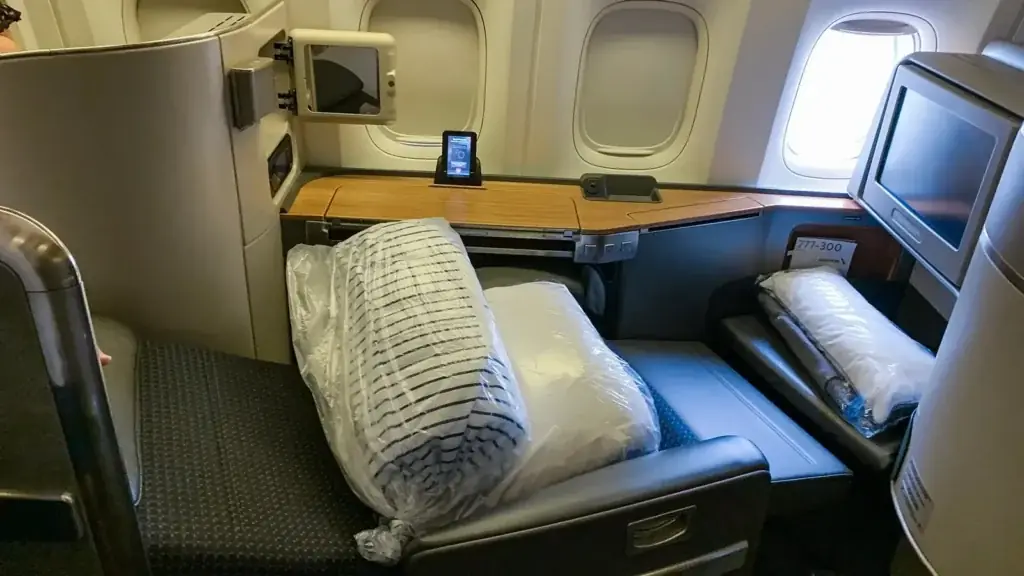
Product delivery also varies according to the assigned aircraft model. Routes flown by widebody Boeing 777 or 787 jets offer lie-flat suites with direct aisle access. Parallel flights operated by standard Airbus A321 or Boeing 737 aircraft deliver traditional recliners with limited tilt and shared central consoles.
Deep Contextual Background
Historically, domestic premium travel operated under a uniform service standard established during the regulated era of commercial aviation. Fares were controlled by federal regulatory bodies, forcing carriers to compete primarily on onboard dining, legroom spacing, and cabin hospitality rather than distinct physical seat engineering.
Deregulation and Fleet Standardization
Following airline deregulation, carriers reconfigured cabin layouts to optimize seat density and yield per available seat-mile. Domestic front cabins transitioned toward standardized recliner seating, while lie-flat bed technology was reserved exclusively for long-haul international routes.
The Transcontinental Flagship Era
In response to growing competition on transcontinental routes, American Airlines introduced specialized sub-fleets, including the three-class Airbus A321T. These aircraft featured First Class suites, Business Class lie-flat seats, and dedicated main cabin extra seating for high-yield coastal markets.
Today, the domestic premium network splits into two primary operational tiers: standard domestic First Class across the broader domestic hub network and Flagship Transcontinental products servicing key coast-to-coast corridors.
Conceptual Frameworks and Mental Models
The Usable Space Equity Index
This analytical framework evaluates the usable physical area delivered by a seat relative to the ticket fare charged.
Calculating this metric prevents overpaying for narrowbody recliner seats priced at levels comparable to transcontinental lie-flat suites.
Integrated Ground-to-Air System Model
A thorough evaluation assesses the travel experience across ground check-in lobbies, security processing, lounge amenities, and inflight seat comfort.
Route Competition Mechanics
This model predicts front-cabin seat quality based on carrier competition along a specific city pair. High competition forces airlines to operate lie-flat widebody aircraft, whereas low competition leads to standard narrowbody recliners.
Key Categories or Variations
American Airlines’ domestic first class destinations span several distinct operational tiers.
1. Flagship Transcontinental Coastal Corridors
Servicing major non-stop routes like New York (JFK) to Los Angeles (LAX) and San Francisco (SFO), these routes feature lie-flat seating, multi-course dining, and Flagship Lounge access.
2. Long-Haul Island Destinations (Hawaii)
Connecting major mainland hubs like Dallas/Fort Worth (DFW) and Phoenix (PHX) to Honolulu (HNL) and Maui (OGG), these routes frequently deploy widebody aircraft with lie-flat seating.
3. Domestic Hub Repositioning Routes
Carriers fly widebody aircraft between major domestic hubs (such as DFW, Miami, and Chicago O’Hare) to position planes for international departures, offering lie-flat seats on domestic flights.
4. Mainline Domestic Trunk Routes
Connecting primary hub airports on medium-haul flights, these routes utilize Boeing 737 and Airbus A321 narrowbody jets equipped with standard 2-2 recliner seating.
5. Short-Haul Regional Feeder Corridors
Serviced by regional carrier partners operating dual-class regional jets, these flights offer 1-2 recliner seating for single travelers on short connector flights.
6. High-Density Seasonal Resort Corridors
Connecting primary hubs to seasonal mountain and beach destinations, these routes feature standard narrowbody recliners with adjusted seasonal schedules.
Domestic Destination Product Comparison
Detailed Real-World Scenarios
Scenario A: Transcontinental Executive Travel
A corporate executive flies non-stop between New York (JFK) and Los Angeles (LAX) for a morning presentation.
-
Constraint: Need to arrive fully rested with zero recovery time.
-
Decision Point: Choosing between a dedicated transcontinental flight and a one-stop connection on a narrowbody jet.
-
Evaluation: Selecting the Flagship non-stop route provides a lie-flat bed, Flagship Check-In, and Flagship Lounge access, justifying the higher fare.
Scenario B: Long-Haul Leisure Trip to Hawaii
A traveler flies non-stop from Dallas/Fort Worth (DFW) to Honolulu (HNL).
-
Constraint: Flight duration exceeding eight hours.
-
Decision Point: Selecting a direct widebody flight versus a two-stop narrowbody routing.
-
Evaluation: Booking the non-stop widebody flight guarantees lie-flat seating and elevated inflight comfort across a long flight duration.
Scenario C: Hub Repositioning Discovery
A leisure traveler flies between Miami (MIA) and Dallas/Fort Worth (DFW).
-
Constraint: Seeking lie-flat comfort on a standard domestic budget.
-
Decision Point: Choosing a flight operated by an international Boeing 777 widebody over a parallel Boeing 737 departure.
-
Evaluation: Selecting the widebody repositioning flight provides a full lie-flat suite for the cost of a standard domestic first class fare.
Planning, Cost, and Resource Dynamics
Evaluating the financial dynamics of domestic front-cabin travel requires looking past baseline fares to examine net value delivery. Identifying true market value across american first class travel destinations usa helps travelers spend travel budgets efficiently.
Strategic Capital Allocation
Travelers should weigh cash fares against upgrade bids, mileage redemptions, and elite status upgrades. Investing cash in dedicated Flagship transcontinental suites provides a clear return in comfort, whereas cash spent on short-haul recliners often yields lower returns.
Tools, Strategies, and Support Systems
Strategy 1: Tail-Number Fleet Tracking
Utilizing aircraft tracking tools allows travelers to identify specific aircraft registrations and confirm exact seating layouts prior to booking.
Strategy 2: Widebody Repositioning Discovery
Searching for domestic legs operated by long-haul widebody aircraft unlocks lie-flat seating at standard domestic fare prices.
Strategy 3: Flagship Ground Infrastructure Utilization
Booking qualifying transcontinental routes provides access to Flagship Check-In, expedited security lanes, and Flagship Lounges.
Strategy 4: Unbundled Premium Fare Inspection
Reviewing exact fare codes ensures that selected premium tickets include expected amenities such as seat selection and baggage allowances.
Risk Landscape and Failure Modes
Unannounced Aircraft Substitutions
Carriers reserve the right to swap aircraft types due to maintenance or operational disruptions. Replacing a lie-flat widebody with a narrowbody recliner significantly reduces product value.
Disrupted Lounge Amenities
Lounge overcrowding or adjusted operating hours can reduce the value of ground benefits on Flagship transcontinental tickets.
Inconsistent Meal Delivery
Catering disruptions on short domestic legs or regional feeder flights can result in reduced meal options despite paying full premium fares.
Governance, Maintenance, and Long-Term Adaptation
Evaluating travel options systematically ensures consistent value delivery across all itineraries.
Measurement, Tracking, and Evaluation
Tracking key performance metrics helps travelers evaluate the return on their premium fare investments over time.
Performance Evaluation Matrix
Common Misconceptions and Oversimplifications
Myth 1: First Class Always Includes Lounge Access
Standard domestic first class tickets exclude Flagship Lounge access unless paired with designated transcontinental or Hawaii routes.
Myth 2: All First Class Seats Are Lie-Flat
The majority of domestic first class seats are standard recliners; lie-flat suites operate mainly on transcontinental or widebody routes.
Myth 3: Premium Fares Guarantee Superior Catering
Meal service quality varies widely based on flight distance, departure time, and airport catering capabilities.
Myth 4: Larger Aircraft Always Deliver Better Service
Flight crews on widebody jets serve a higher volume of passengers, which can slow inflight service compared to narrowbody cabins.
Ethical, Practical, or Contextual Considerations
Evaluating premium air travel involves balancing personal comfort against corporate travel policies and environmental considerations. Premium cabin seating occupies a larger physical footprint per passenger, resulting in higher carbon emissions per seat mile. Travelers can weigh these factors when determining whether a premium booking is necessary for a given route.
Conclusion
Navigating american first class travel destinations usa requires evaluating aircraft hardware, route network rules, and ground amenities. By focusing on specialized transcontinental routes, widebody repositioning opportunities, and Flagship ground access, travelers can secure exceptional comfort. A structured evaluation process ensures that every premium fare dollar delivers tangible value.